

Face Recognition vs Fingerprint Attendance: Which Suits Your Office?
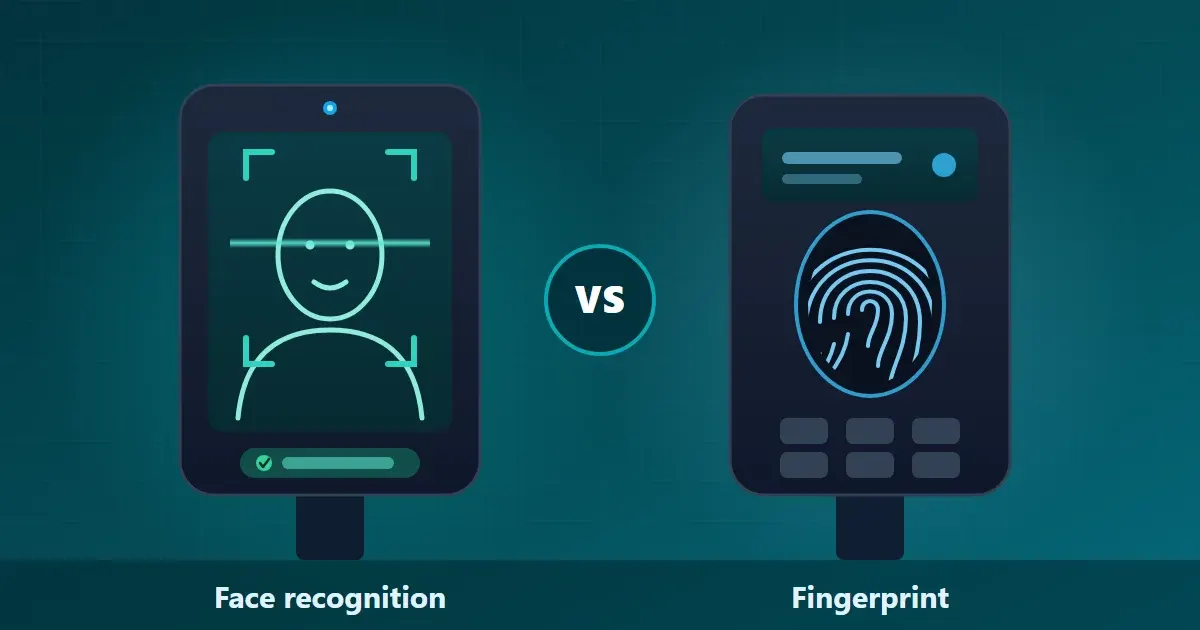
Choose a face recognition attendance system if your staff arrive in groups at shift change, work with their hands, or you want check-in to be touchless. Choose a fingerprint attendance system if your team is small, people arrive steadily through the day and you want the simpler, usually lower-cost device. Both keep reliable attendance records when the device suits the site, so the right answer depends on your staff, your entrances and how you run payroll.
This guide to face recognition vs fingerprint attendance compares the two in everyday use: how each one works, where each struggles, and what to check before you decide. It draws on the biometric attendance and access systems we install in Kerala for offices, showrooms and factories in Kozhikode, Wayanad, Malappuram and Kannur.
How fingerprint and face recognition attendance work
Both systems do the same job: they identify a person and record the time they arrived or left. The difference is what they read.
Fingerprint attendance system
Each person is enrolled once by placing a finger on the sensor a few times. At check-in they place the same finger on the reader, the device matches it against the enrolled records and logs the time. Many fingerprint devices also accept a PIN or a card on compatible models, which helps when a finger does not read.
Face recognition attendance system
Each person is enrolled once by standing in front of the terminal while it captures their face. At check-in they look at the screen, the camera matches their face and the time is logged. Nobody touches the device, and nobody needs to carry a card or remember a PIN.
In both cases the device keeps the enrolment data and the attendance log, and attendance software turns those logs into daily and monthly reports. How the data is stored depends on the model, which is one of the things worth asking before you buy.
Speed, hygiene and accuracy in daily use
Speed at busy times
One person checking in takes a moment on either device. The difference shows when twenty people arrive in the same five minutes. Face recognition lets each person keep moving: they look at the screen and walk on. A fingerprint reader needs each person to stop and place a finger, and a queue forms quickly if a finger has to be tried twice.
Hygiene
A fingerprint sensor is touched by every member of staff, every day, so it needs regular cleaning. Face recognition gives touchless attendance, which is why many offices, clinics and food businesses prefer it.
When each one struggles
Neither technology is perfect in every setting, and the problems are different:
Fingerprint readers can fail to read worn, cut, very dry, wet, oily or dusty fingers. That matters in workshops, kitchens, construction and anywhere people work with their hands.
Face recognition needs sensible placement. Strong sunlight or bright backlight behind the person, a terminal mounted at the wrong height, or caps and helmets left on can all slow recognition. How well a device copes with masks depends on the model.
We do not quote accuracy percentages. Real-world results depend on the device, the quality of enrolment and where the terminal is mounted, so we look at your entrance before recommending one.
Staff numbers, entry points and shift patterns
Three practical questions narrow the choice quickly.
How many people will use it? Every device has a limit on enrolled users and stored records. A small office is comfortably within any device's limits; a large factory needs a terminal sized for its headcount.
How many entrances do staff use? One terminal per check-in point is simplest. If staff come in through more than one door, decide whether each entrance needs a device or whether everyone checks in at one point.
When do people arrive? Shift changes create peaks. If many people check in at once, a touchless device or a second terminal avoids a queue at the door.
Face recognition vs fingerprint attendance at a glance
| Factor | Face recognition | Fingerprint |
|---|---|---|
| Contact | Touchless | Finger placed on the sensor |
| Busy shift changes | Usually quicker for groups | Queues can form |
| Hands-on work (oil, dust, wear) | Not affected by the condition of fingers | Reads can fail on worn or dirty fingers |
| Bright sunlight or backlight | Needs careful placement | Not affected |
| Masks, caps and helmets | Depends on the model; caps and helmets usually come off | Not affected |
| Backup method | PIN or card on compatible models | PIN or card on compatible models |
| Device cost | Usually higher | Usually lower |
Reports, payroll exports and door access
The device records the time; the attendance software is where the records become useful. It typically shows who arrived late, who left early and how many hours each person worked, and it produces monthly reports for salary processing. The exact reports depend on the software supplied with the device.
If you run payroll in separate software, ask how the records get there. Many systems export reports, for example to a spreadsheet, but whether that file imports directly into your payroll software depends on the payroll software itself. We confirm this before recommending a device, rather than after it is installed.
Many attendance devices can also control a door. Connected to an electric lock and an exit button, a compatible device opens the door only for authorised people, so one terminal handles both attendance and entry. Whether this is possible depends on the model and the door, and it is part of our access control and biometric attendance service.
Which to choose for offices, showrooms and factories
Offices
For a small office where people arrive steadily, a fingerprint device does the job simply. Face recognition makes sense when the team is growing, when hygiene matters, or when you also want the device to control the office door. See how we approach networking, access control and attendance for corporate offices.
Showrooms and dealerships
Sales floors suit face check-in: staff do not need to carry a card or remember a PIN, and check-in takes seconds. At a car dealership in Kozhikode we installed a face recognition attendance terminal alongside CCTV, so staff simply look at the screen to mark attendance. More on our work for car showrooms and dealerships.
Factories and workshops
Where hands get oily, dusty or worn, fingerprint reads become unreliable and face recognition is usually the better fit. Placement matters more here: keep the terminal out of direct sunlight and away from the dust and spray of the work area.
Controlled entry as well as attendance
If certain rooms should open only for authorised people, face recognition can control access too. For an IT company we installed face recognition access control at designated entry points, together with CCTV and the network behind it.
What we check during a site survey
Before recommending a device, we look at the things that decide whether it will work well on your premises:
how many staff you have, and how shifts and arrival times are spread through the day;
each entrance staff use, the light at that spot, and where power and network cabling can reach the device;
whether you also need door control, and what lock suits the door;
your payroll software and the report format your office needs;
who will enrol new staff and remove people who leave.
Biometric data is personal information, so plan how you will handle it: tell staff what the system records and why, limit who can manage the device, and remove the records of people who leave. We enrol your staff and train your office administrator to manage the system after installation.
The short answer
Fingerprint attendance is a sound, economical choice for small teams with steady arrivals and clean, dry hands. Face recognition is the better fit for busy shift changes, hands-on work, touchless check-in, or when one device should also control a door. If you are unsure, the conditions at your entrance usually settle it.
Tell us how many staff and doors you have, and we will recommend a system after a free site survey. Contact us, or see our access control and biometric attendance service in Calicut.
Frequently Asked Questions
Planning Access Control & Biometric Attendance?
Molvbo can assess your site, recommend a practical design and send a quotation for sites in Kozhikode, Wayanad, Malappuram and Kannur.